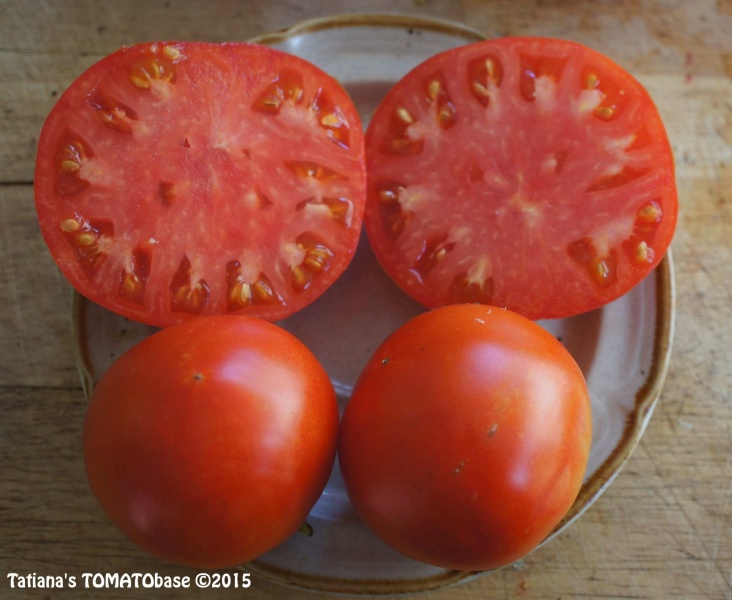
Tomato Quebec 309 (Solanum lycopersicum)
Cold-hardy tomato, early, sweet, productive, disease-resistant.
La tomate Québec 309 est une variété à rendement élevé, produisant des tomates de taille moyenne, rondes et d’un rouge vif. Elle a été développé par M. J. O. Vandal. Elle était annoncé dans le catalogue de Semences Laval en 1955, et le journal Le Soleil en 1958.
Elle est adaptée aux climats plus frais et mûrit tôt dans la saison. Résistante aux maladies courantes, elle offre des tomates au goût sucré, idéales pour la consommation fraîche ou la mise en conserve. Très appréciée pour sa robustesse et sa capacité à s’adapter aux conditions du nord du Canada.
| Quantity: Envelope of about 30 seeds |
| Plant type: Annual |
| Family: Solanaceae |
| Color: Red |
| Plantation: In the garden after the risk of frost |
| Sowing: Inside |
| Row spacing: 70 cm |
| Days to maturity: 65 to 75 days |
| Germination: 7 to 10 days |
| Plant spacing: 45 cm |
| Depth: 5 mm |
| Exposure: Full sun |
| Watering: Regular |
| Soil: Well drained |
| Shape: Herbaceous |
| Type of growth: Indeterminate growth |
| Width: 45 cm with tutor or 60 cm if left on the ground |
| Height: 1 m |
![[342] Iberville Tomato (Solanum lycopersicum)](/web/image/product.product/1121/image_128/%5B342%5D%20Iberville%20Tomato%20%28Solanum%20lycopersicum%29?unique=c346884)
![[303] Mémé de Beauce Tomato (Solanum lycopersicum)](/web/image/product.product/480/image_128/%5B303%5D%20M%C3%A9m%C3%A9%20de%20Beauce%20Tomato%20%28Solanum%20lycopersicum%29?unique=4d777ad)
![[317] Plourde tomato (Solanum lycopersicum)](/web/image/product.product/474/image_128/%5B317%5D%20Plourde%20tomato%20%28Solanum%20lycopersicum%29?unique=98c4e6c)
![[330] Quebec Blood Tomato (Solanum lycopersicum)](/web/image/product.product/765/image_128/%5B330%5D%20Quebec%20Blood%20Tomato%20%28Solanum%20lycopersicum%29?unique=17b27af)
![[331] Savignac tomato (Solanum lycopersicum)](/web/image/product.product/481/image_128/%5B331%5D%20Savignac%20tomato%20%28Solanum%20lycopersicum%29?unique=5bb97e8)
![[320] Tomato Quebec #13 (Solanum lycopersicum)](/web/image/product.product/583/image_128/%5B320%5D%20Tomato%20Quebec%20%2313%20%28Solanum%20lycopersicum%29?unique=98165e4)
![[321] Tomato Quebec 2473 (Solanum lycopersicum)](/web/image/product.product/722/image_128/%5B321%5D%20Tomato%20Quebec%202473%20%28Solanum%20lycopersicum%29?unique=3af6853)